

If you’ve been searching for play area organisation ideas that actually stick, you’re not alone. The play space is one of the hardest areas in a family home to keep under control — not because your kids are particularly messy, but because most storage systems are designed without real children using them in mind.
The good news? Getting the play area under control is absolutely doable, even with pre-teens who have accumulated years of stuff. It just takes the right approach — and it always starts before you buy a single basket.
Quick Takeaways
- Decluttering before organising is non-negotiable — storage without sorting just hides the problem
- Zones work better than toy categories because kids can maintain them independently
- The most sustainable systems take five minutes or less to reset at the end of each day
Why Does the Play Area Always End Up in Chaos?
The toy chaos isn’t a willpower problem. It isn’t a parenting problem. It’s a systems problem — and usually one that was set up with good intentions but without a realistic plan for how your kids actually play and put things away.
A few patterns come up again and again in Melbourne family homes: too much stuff with not enough clearly defined homes for it, storage containers that are too big or too deep (making it hard for kids to retrieve things without upending everything), and a mix of old toys with new ones where nothing has a clear spot any more.
The other thing worth saying: most kids’ play areas evolve organically over the years. What worked when your child was four doesn’t work at nine. As kids get older, their toys get smaller, more complex, and more numerous — and the original storage setup doesn’t grow with them.
Before any new organisation system can work, you need to understand why the current one is failing. Nine times out of ten, it comes down to too much stuff and storage that isn’t intuitive enough for kids to maintain.
Declutter Before You Organise: Why It Matters in a Play Space
Here’s the most important thing: no amount of clever storage will fix a toy overload. If you organise before you declutter, you’ll spend money on bins and baskets only to find they’re all full within a week — because you haven’t addressed the volume of stuff.
This is where so many families get stuck. They buy the IKEA KALLAX, they get the matching boxes, they spend a Saturday setting it all up — and it still doesn’t hold. Because the problem wasn’t the storage. It was the quantity.
Start by pulling everything out of the play area and sorting into three groups: keep, donate, and bin. Be honest — broken toys, anything untouched in six months, duplicates, sets with missing pieces. These can all go. The general rule I use with clients is that your storage should be about 70% full after the declutter. That breathing room is what allows any play area organisation ideas to actually function day to day.
Once you’ve decluttered, you’ll have a much clearer picture of what you actually need to store — and that makes the next step far more straightforward.
Play Area Organisation Ideas by Zone
The most effective play area organisation ideas work from zones rather than toy categories. Instead of sorting by type (“all the Lego here, all the craft there”), zones work by how often something gets used — and that’s the key to a system kids can actually maintain.
Here’s a simple zone framework that works well for most Melbourne family homes:
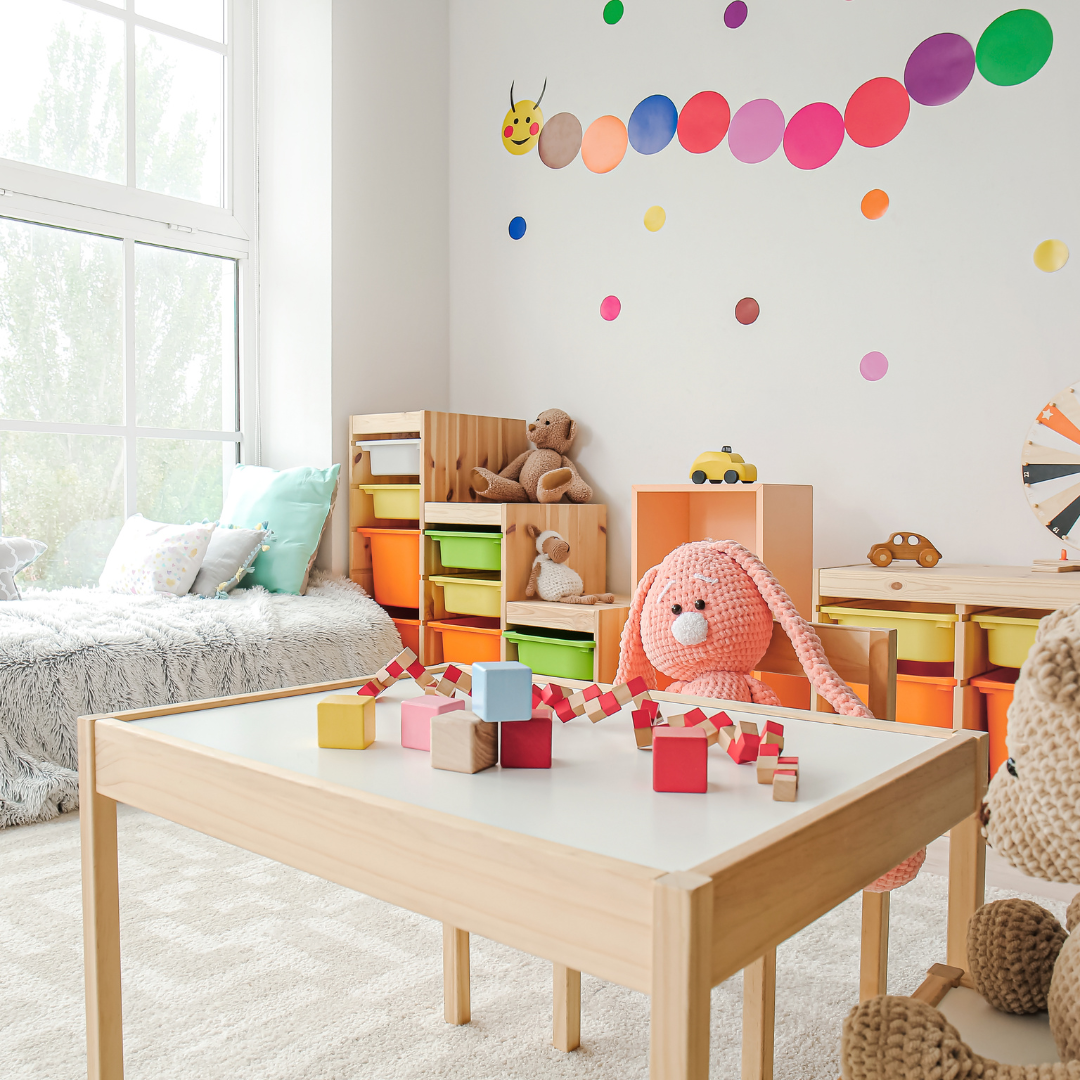
The everyday zone — this is for the toys your kids reach for daily. Think LEGO, art supplies, sensory items, current-favourite books. These should be the most accessible: at arm’s reach, in open bins or on low shelves. Kmart has great open-front storage baskets that work brilliantly here — kids can grab and return without any fuss.
The project zone — board games, puzzles, building sets, anything that requires a deliberate setup. These can live on higher shelves or in lidded boxes because they’re used with intention anyway. Big W stackable storage boxes are perfect for this layer.
The rotation zone — toys your kids love but don’t need constant access to. Store these out of sight and rotate them in every few months. This keeps the play area feeling fresh without spending a cent on anything new, and it reliably cuts down on the “I’m bored” moments.
For labelling: clear storage containers from IKEA or Howards Storage World are a far better choice than opaque bins for this age group. Pre-teen kids can find things without tipping everything out, and they can put things back correctly because the contents are obvious at a glance.
Do Play Area Organisation Ideas Actually Work for Busy Families?
Yes — but only when the system is built around your household’s real habits, not an aspirational version of them.
The biggest reason play area organisation ideas fail is not because the system is wrong. It’s because the system was designed for a child who puts things away perfectly every time, in a household with unlimited time for resetting at the end of each day. Real family life doesn’t look like that.
The most sustainable systems share three things: fewer items overall, an obvious home for each one, and a tidy-up routine that takes five minutes or less. That last point matters more than most families realise. If cleaning up the play area feels like a 45-minute task, no one’s going to do it — not your kids, and honestly, not you either after a long day.
Build in a five-to-ten-minute reset before dinner each evening. Keep it simple: everything back into its zone, not sorted perfectly, just roughly in the right place. That daily reset is what makes the whole system sustainable long-term. It’s the one habit the most organised families I work with all have in common.
Ready to Get Your Home Organised?
If you’d love a professional set of hands to help you declutter and organise your home, Eve and the Ducks in a Row team are here to help. We work with busy Melbourne families to create calm, functional spaces with simple systems that actually stick.